
By the Notion Tech team · Published 17 November 2026 · Legal details checked against the Act and OAIC guidance on 17 November 2026
Picture a sales manager at the end of the financial year. She exports her team’s numbers, pastes them into an AI chat tool and asks for a draft bonus recommendation for each person. The draft looks sensible, she tweaks two figures, and her director signs off in writing. Nobody in that chain would call it “automated decision-making”. The privacy regulator probably would.
That scenario isn’t ours. It’s a near copy of an example the Office of the Australian Information Commissioner (OAIC) published in September, and it’s a good way into a rule that starts on 10 December 2026. From that date, if a computer program makes or substantially shapes a decision that could significantly affect someone, and it uses their personal information, your privacy policy has to say so. AI tools are squarely inside that rule.
The short answer: if your business is covered by the Privacy Act and you use AI to screen, score, rank, price, approve or decline people, you need to find those uses, check how much your staff really rely on the output, and add a plain-English section to your privacy policy before 10 December. Having a person click “approve” at the end doesn’t take a decision out of scope on its own.
We’ve already covered the rule itself in Privacy Act Deadline 10 Dec: Is Your Software Ready?, including spreadsheets and rule-based systems. This piece is narrower. It’s about AI specifically: the chat tools your staff already use, the AI features switched on inside the software you subscribe to, and the agents some businesses are starting to build. It’s general information, not legal advice.
The rule, briefly
The change comes from Part 15 of Schedule 1 to the Privacy and Other Legislation Amendment Act 2024. The Act received Royal Assent on 10 December 2024, and Part 15 commences 24 months later, on 10 December 2026. It adds three new clauses, APP 1.7 to 1.9, to the first Australian Privacy Principle.
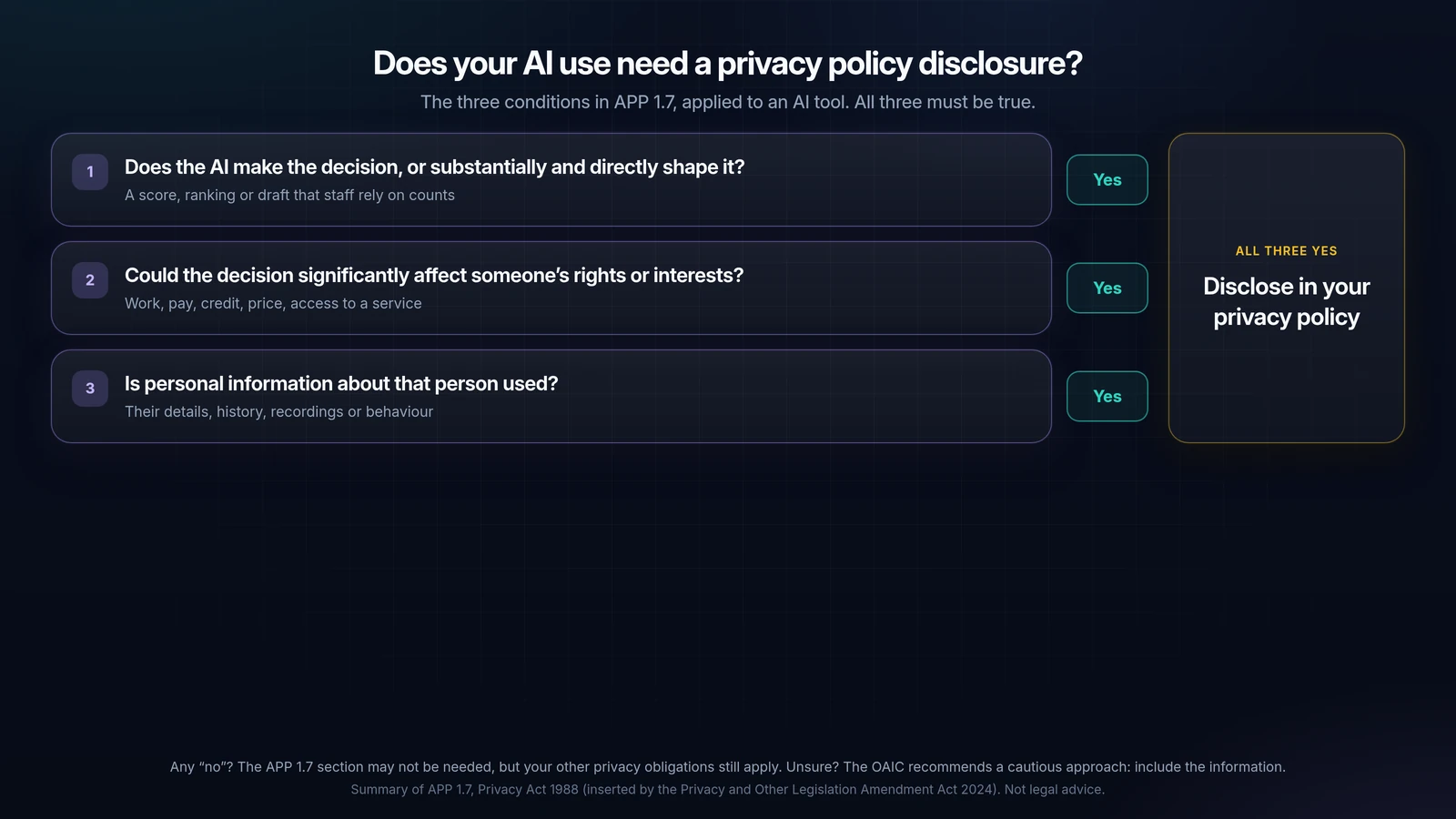
APP 1.7 applies when all three of these are true:
- You have arranged for a computer program to make a decision, or to do something “substantially and directly related to making” one.
- The decision “could reasonably be expected to significantly affect the rights or interests of an individual”.
- Personal information about that person is used when the program does its part.
When they are, APP 1.8 says your privacy policy must describe three things: the kinds of personal information those programs use, the kinds of decisions made solely by a program, and the kinds of decisions where a program does something substantially and directly related to the decision.
Two details in the Act matter more than they first appear. APP 1.9 says making a decision includes refusing or failing to make one, and that a decision can affect someone “adversely or beneficially”. So an AI tool that decides who doesn’t get a call back counts just as much as one that decides who does. And the application clause says the rule covers decisions made after 10 December, even if the system was set up years ago and the data was collected long before. There’s no grandfathering for the tools you already run.
Why AI tools are squarely in scope
The Act doesn’t define “computer program”. The OAIC’s APP 1.7–1.9 fact sheet, published on 30 September 2026 alongside an updated chapter 1 of the APP Guidelines, reads it broadly. Its list includes rule-based processes, machine learning, ordinary software and “generative AI used to generate text, images, videos, code or synthesis, including chatbots”.
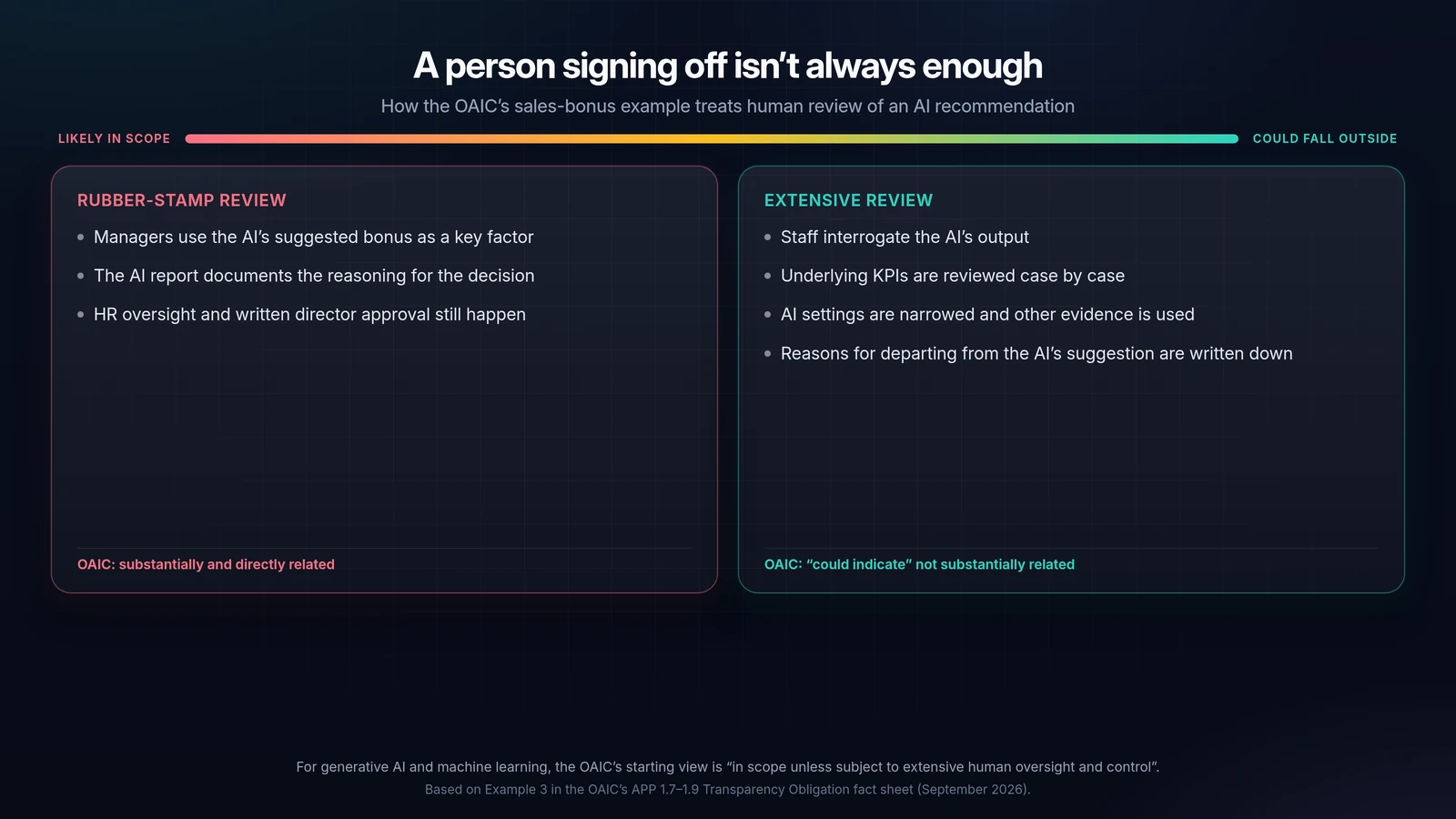
Then comes the line every business using AI should read twice. The OAIC says it considers machine learning or generative AI outputs used to make decisions that significantly affect people “would generally fall within scope of the transparency obligation unless subject to extensive human oversight and control”.
That flips the way many teams think about it. The common assumption is “a person makes the final call, so it’s not automated”. The regulator’s starting position for AI is closer to “it’s in scope, unless your human review is genuinely substantial”.
What the OAIC means by real human oversight
The fact sheet’s sales-bonus example (the one we opened with, featuring a fictional tool the OAIC calls GPTea) spells out the difference. In the first version, managers use the AI’s suggested bonus and salary figures as a key factor, and the recommendation is relied on to document the reasoning. Even with HR oversight and written director approval, the OAIC says the AI output is substantially and directly related to the decision.
In the second version, staff interrogate the outputs, review the individual performance indicators behind them, set the tool’s parameters more narrowly, bring in other evidence, and write down why they departed from the AI’s recommendation. The OAIC says that “could indicate” the output was not substantially related to the decision.
Note the careful wording: “could indicate”, not “will”. Real oversight takes effort. If your reviewers approve most AI suggestions within a minute, assume you’re in scope and disclose. That’s also what the OAIC recommends when you’re unsure: take a cautious approach and include the information.
Where AI actually shows up in a business
Most businesses can name the AI tools they pay for. Fewer can name the AI features that arrived quietly inside software they already had, or the free chat tools staff use on their own initiative. All three count if they shape significant decisions about people.
Here’s how common AI uses line up against the rule. It’s our reading of the OAIC’s guidance and examples, not a ruling, and your facts may change the answer.
| AI use | Example | Likely in scope? | Why |
|---|---|---|---|
| Screening job applicants | An AI feature in your recruitment platform ranks applicants or scores video interviews | Yes | The OAIC lists recruitment software as generally in scope and uses AI interview scoring as an example |
| Pay, bonuses and performance | A manager asks a chat tool to rank staff or suggest bonuses from KPI data | Yes, unless review is extensive | The OAIC’s own GPTea example covers this exact use |
| Credit, payment plans and fraud checks | An AI model approves or declines a payment plan or flags an account | Yes | Loan and credit decisions, and blocking access to accounts, appear in the OAIC’s examples |
| Personalised pricing | Software sets a price for one customer based on their address or history | Yes, for significant goods and services | The OAIC says even small price differences can be significant over time |
| Prioritising care or support | A tool ranks clients for health, disability or aged-care services | Yes | Prioritising health or disability services is on the OAIC’s list of in-scope decisions |
| Customer service chatbot | A chatbot answers questions but hands refunds and complaints to staff | Less likely | It isn’t making or shaping a significant decision, but check whether it ever refuses anything |
| Drafting marketing copy | Staff use AI to write newsletters and social posts | Unlikely | No decision about an individual |
| Meeting notes and summaries | An AI note-taker summarises team meetings | Usually not | It becomes relevant if the summaries feed into performance or disciplinary decisions |
Two things stand out from that table. First, the riskiest uses are often the least visible: a manager’s private chat window, or a scoring feature a vendor switched on in an update. Second, the line isn’t “AI or not”. It’s what the output is used for. The same note-taking tool can be harmless in a planning meeting and in scope when its transcript ends up in a performance review.
The chat tools nobody signed off on
If staff paste customer or employee details into a public AI chat tool, you have a privacy problem before APP 1.7 even comes into it. The OAIC’s separate guidance on commercially available AI products says privacy obligations apply to personal information put into an AI system and to AI output that contains personal information. As a matter of best practice, it recommends organisations don’t enter personal information, and particularly sensitive information, into publicly available generative AI tools at all.
So the practical fix for shadow AI isn’t a privacy policy paragraph. It’s a short staff rule about which AI tools are approved, what information can go into them, and which decisions they must never be used for without a documented review. The policy paragraph comes after you know what’s actually happening.
Buying AI doesn’t hand over the obligation
A lot of AI arrives through software you subscribe to: an HR platform, a rostering system, a CRM, a lending or payments tool. It’s tempting to assume the vendor carries the compliance load. The OAIC says otherwise. Its fact sheet says APP 1 obligations “typically remain with the APP entity” using the personal information to make the decision.
The guidance also says that procuring a third-party program, configuring or customising off-the-shelf software, or relying on a program’s advisory outputs can all count as “arranging for” a computer program to make or inform a decision. In its affordable-housing example, a provider bought an AI-powered software service to help decide who gets housing next. The OAIC said the provider had “arranged for” the program regardless of whether it could customise the decision settings.
The OAIC does expect vendors to help. Providers of third-party software “should provide clear, high-level information” about how their software can be used to make decisions, so customers can write their privacy policies. That gives you a reasonable basis to ask your suppliers some direct questions:
- Which features in your product use AI or automated scoring, and are any switched on by default?
- What kinds of personal information does each feature use? Does it use anything sensitive, such as health information or biometric data?
- Does the feature make a decision on its own, or produce a score or recommendation for a person to act on?
- Can we see why it reached a particular result, in a form we could explain to a customer or employee?
- Can we turn the feature off, narrow its settings, or require a person to review its output?
- Is our data used to train or improve your models, and where is it processed?
If a vendor can’t answer the first three questions in plain words, you’ll struggle to write an accurate privacy policy. That alone is useful to know before your next renewal.
What to write in your privacy policy
The OAIC’s fact sheet includes two sample sections, one for a fictional bank and one for a fictional government agency. Both use the same simple shape: a heading such as “Decisions made by computer programs”, a list of the kinds of personal information used, and a list of the kinds of decisions those programs make or support. They group things into categories rather than listing every system or algorithm.
The guidance asks for information that’s meaningful to a reasonable person without burying them in technical detail. You can group decisions and types of information, but where more sensitive information is used, such as health information or biometric templates, the OAIC says that should be clear.
Here’s how the three things APP 1.8 asks for map onto an AI example. The example column is our illustration for a hypothetical business, not wording from the OAIC.
| APP 1.8 asks for | What it means in practice | Illustrative example |
|---|---|---|
| 1.8(a) Kinds of personal information used | Group the inputs into plain categories, and call out sensitive ones | Application details, employment history, video interview recordings |
| 1.8(b) Kinds of decisions made solely by a program | Decisions where no person reviews the result before it takes effect | Automatically declining applications that don’t meet a minimum requirement |
| 1.8(c) Kinds of decisions a program substantially and directly shapes | Decisions a person makes, where an AI score, ranking or draft is a key factor | Shortlisting candidates for interview using an AI-generated ranking |
A sample section for a hypothetical recruitment process might read like this. Treat it as a starting point for a conversation with your lawyer, not something to copy.
“Decisions made by computer programs. We use recruitment software with AI features to help assess job applications. It uses the details in your application, your work and education history, and your answers in any recorded video interview. The software ranks applications, and our hiring team uses that ranking when deciding who to invite to interview. The software does not make final hiring decisions. You can ask us for more information about how a decision about you was made.”
That last sentence isn’t strictly required by APP 1.8, but the guidance encourages policies structured so people can ask for more information and so decisions can be reviewed. If you put it in, make sure someone can actually answer the question.
What you can keep confidential
The OAIC confirms that commercially sensitive information and trade secrets about your programs are excluded. In its fraud-detection example, a lender didn’t have to disclose how its in-house model weights each data point, but it did have to disclose that it uses personal information to detect fraud and decide on accounts, transactions and loan applications. The exclusion protects the recipe, not the fact that you’re cooking. It also doesn’t cover information that would merely be embarrassing or attract criticism.
Who has to do this
The rule applies to APP entities: Australian Government agencies and organisations covered by the Privacy Act. According to the OAIC’s small business page, most businesses with an annual turnover of $3 million or less aren’t covered, but plenty are regardless of size. That includes health service providers, businesses that trade in personal information, Commonwealth contracted service providers, credit reporting bodies, AML/CTF reporting entities (for that part of their work) and businesses related to a covered business.
The health service provider exception catches a lot of the care sector. If you run a small allied health practice or a disability or aged-care service that holds health information, assume you’re covered and check. The OAIC’s own first example in the fact sheet is a health and aged-care provider using a spreadsheet formula to decide which clients to contact first.
If you’re genuinely exempt, the rule doesn’t bind you. It’s still worth doing the inventory. Larger customers, funders and enterprise buyers may ask suppliers how they use AI, and having an answer ready is easier than scrambling for one during a tender.
What happens if you get it wrong
The Act makes a failure to include the APP 1.7 information a civil penalty provision under section 13K. The maximum penalty for that provision is 200 penalty units. At the Commonwealth penalty unit value of $364 that applies from 1 July 2026, according to the ATO, that’s $72,800 before you look at how penalties apply to companies. The amended Act also lets the OAIC issue infringement notices and compliance notices for that provision without first going to court.
Those numbers are modest next to the Privacy Act’s serious-breach penalties, and that’s partly the point. This is designed to be cheap to enforce. A privacy policy is public, so a missing section is easy for the regulator, a journalist or an unhappy applicant to spot. The bigger cost is usually the complaint that follows a decision someone thinks was unfair, when you discover you can’t explain how the AI got there.
The honest trade-offs
There are a few places where doing this well isn’t straightforward.
Extensive review costs real time. If you want an AI tool’s output to sit outside the rule, the OAIC’s example suggests your people need to interrogate the result, check the underlying evidence and document disagreements. For high-volume work, that can wipe out much of the time AI was meant to save. For most businesses, it’s simpler to disclose honestly and keep a lighter review step than to pretend the review is deeper than it is.
Guidance isn’t law. The fact sheet and guidelines are the OAIC’s view of how it will apply the Act. A court could read the words differently, and the OAIC may refine its guidance after the rule has run for a while. The safe course is to follow the guidance now and check for updates.
Over-disclosing has a cost too. Listing every tool that touches personal information makes a policy long and unhelpful. The rule is about decisions that significantly affect people. Note-taking, spell-checking and drafting marketing copy don’t need to be there.
Your vendors may not be ready. Some suppliers will have neat answers. Others will send a generic security document that doesn’t mention decisions at all. You may have to write your disclosure from what you can observe and correct it later, which is fine as long as you keep it up to date.
A three-week plan before 10 December
As of today there are just over three weeks until the rule starts. Here’s a realistic order of work for a small or mid-sized business. Adjust it to your size.
This week: find the AI. List every tool that makes or shapes decisions about customers, clients, applicants or staff. Include paid AI tools, AI features inside existing software and the free chat tools people use. A short anonymous survey of staff can surface uses that a review of software invoices would miss.
Next week: classify and ask. Run each use through the three questions in the Act. For anything that’s in scope or borderline, send your vendors the questions above and work out honestly how much your people review the output.
The week after: write and publish. Add a “Decisions made by computer programs” section to your privacy policy, get it checked by someone qualified, and publish it before 10 December. At the same time, give staff a one-page AI-use rule covering approved tools, what information can’t go in, and which decisions always need a documented human review.
After that: keep it current. AI features change with every software update. Add a check of your AI uses to whatever review you already do for new software, and revisit the policy section at least once a year.
How we build decision software for this
When we build software that assesses, ranks, prices or allocates, we design for the questions this rule raises. That means recording the inputs, the model or rule version and the result for each decision, so a single case can be traced later. It means showing staff a plain-English reason alongside any AI score, giving them a way to override it with a recorded reason, and keeping sensitive fields out of AI prompts unless they’re genuinely needed. It also means a switch to send a decision type to manual review when something looks off.
None of that is required word for word by APP 1.7. It just makes the privacy policy easy to write and a complaint much easier to answer. If you’re adding AI to a process that affects people, our AI agents and automation service covers building it with approvals and logs from the start, and our custom software development team can review an existing system. For the wider picture, see Australia’s AI safety rules for business and what AI agents can do for a small business.
This article is general information, not legal advice. The Act, the OAIC fact sheet and the APP Guidelines linked above were checked on 17 November 2026. Speak to a privacy lawyer about how the rule applies to your business.