By the Notion Tech team · Published 24 November 2026 · GitHub star counts and licences fetched from the GitHub API on 24 November 2026 (about 8:55pm Sydney time)
Ask a developer how they’d build an AI agent for your business and there’s a good chance the next word out of their mouth is the name of a framework. LangGraph. CrewAI. The OpenAI Agents SDK. Something from Google or Microsoft. If you’re the person paying for the project, those names can sound like interchangeable brands of the same thing. They aren’t, and the choice affects how long the build takes, which AI models you can use, and how hard it will be to change course in two years.
This guide is for the person signing off, not the person typing. We’ve picked 20 open-source agent frameworks and builders on GitHub, sorted them by type, and explained each in plain English. We also flag a handful of well-known names that have recently been archived, replaced or moved, because a surprising number of tutorials still point to them.
The short answer: if your team already lives in one cloud, start with that vendor’s kit (Google’s ADK, AWS’s Strands Agents, Microsoft Agent Framework or OpenAI’s Agents SDK) and check it isn’t locking you to one model. If you need fine control over long-running, multi-step processes, LangGraph is built for exactly that job. If you want non-developers to build and adjust workflows, look at a visual builder such as n8n, Dify or Langflow, and read the licence first. Whatever you pick, budget for testing, logging and human approval steps. The framework is the easy part.
What an agent framework actually does
An AI model on its own answers a question and stops. An agent keeps going. It reads a request, decides what to do, calls a tool (search your CRM, read a PDF, draft an email), looks at the result, and decides on the next step, until the job is done or it hits a limit.
A framework is the plumbing that makes that loop manageable. Most of them handle the same core jobs:
- Talking to models. One interface for OpenAI, Anthropic, Google, local models and others, so you can swap without rewriting everything.
- Tools. A standard way to give the agent abilities, increasingly through the Model Context Protocol (MCP), which we compared with Google’s A2A protocol in MCP vs A2A.
- Memory and state. Keeping track of what’s happened so far, sometimes across days.
- Control. Turn limits, budgets, retries, and pausing for a human to approve a risky step.
- Visibility. Tracing what the agent did and why, so someone can check its work.
You could write all of this yourself. Plenty of teams start that way. Strands Agents makes a telling pitch in its README: choose it when you would otherwise write your own agent loop. That is the real question a framework answers. Do you want to own the plumbing, or rent a well-tested version of it?
Frameworks are also different from agent skills, which we covered last week. A skill is a packet of instructions an agent can pick up. A framework is the engine that runs the agent in the first place.
How we chose these 20, and how to read the numbers
We started from our own research list of GitHub repositories in the agents and LLM frameworks category, added the official kits from the big AI vendors, and then checked every repository’s README and status on 24 November 2026. We dropped document converters, model gateways and web scrapers that often appear in “agent” lists but aren’t frameworks. We also moved archived or replaced projects into their own section rather than recommending them.
This is a research guide, not a lab test. We haven’t benchmarked these frameworks against each other, and we don’t publish performance claims we can’t check. Descriptions come from each project’s own README, GitHub description or official announcement, and where a claim is the publisher’s own, we say so.
Star counts and licences were pulled from the GitHub API at about 8:55pm Sydney time on 24 November 2026. They change daily. A star is a bookmark. It tells you a project gets attention, not that it’s safe, well run or right for you. The visual builders in particular attract stars from a much wider audience than developer libraries, so don’t compare a builder’s count with a library’s and draw conclusions.
On licences, GitHub only names a licence when it recognises a standard file. Where it couldn’t, we read the licence file ourselves and describe it in the table. “Open source” also covers a range of terms here. Some projects are plain MIT or Apache 2.0. Others add conditions for commercial or hosted use. If you plan to build a product on one, have someone read the licence properly.
The 20 frameworks at a glance
| Repository | Stars (24 Nov 2026) | Licence | What it’s for |
|---|---|---|---|
| n8n-io/n8n | 211,928 | Sustainable Use License (fair-code) | Visual workflow automation with AI agent steps |
| langgenius/dify | 161,811 | Modified Apache 2.0 with extra conditions | Visual platform for AI apps, agents and RAG |
| langflow-ai/langflow | 156,899 | MIT | Visual builder for agents and flows, served as APIs or MCP tools |
| langchain-ai/langchain | 149,968 | MIT | General framework and integrations for LLM apps and agents |
| bytedance/deer-flow | 85,733 | MIT | Ready-made long-running research and coding agent harness |
| crewAIInc/crewAI | 61,220 | MIT | Role-based teams of agents plus scripted flows |
| run-llama/llama_index | 52,989 | MIT | Agents and RAG over your documents |
| langchain-ai/langgraph | 45,345 | MIT | Low-level control of long-running, stateful agents |
| agno-agi/agno | 43,279 | Apache 2.0 | Building agents and running them as services |
| openai/openai-agents-python | 30,850 | MIT | OpenAI’s lightweight multi-agent SDK |
| huggingface/smolagents | 30,506 | Apache 2.0 | Minimal agents that act by writing code |
| mastra-ai/mastra | 29,780 | Apache 2.0, except ee/ folders | TypeScript framework for agents and workflows |
| vercel/ai | 28,162 | Apache 2.0 | TypeScript toolkit for AI features in web apps |
| deepset-ai/haystack | 27,098 | Apache 2.0 | Explicit pipelines for search, RAG and agents |
| google/adk-python | 22,338 | Apache 2.0 | Google’s Agent Development Kit |
| pydantic/pydantic-ai | 21,360 | MIT | Typed Python agent framework |
| camel-ai/camel | 18,054 | Apache 2.0 | Research-oriented multi-agent framework |
| strands-agents/harness-sdk | 9,283 | Apache 2.0 | AWS’s open-source agent SDK and harness |
| anthropics/claude-agent-sdk-python | 8,635 | MIT | Build agents on the Claude Code engine |
| ag2ai/ag2 | 5,084 | Apache 2.0 | Community successor to the original AutoGen |
Sorted by stars, which is the least useful way to choose. The sections below group them by the kind of team they suit.
The vendor kits: OpenAI, Google, AWS, Anthropic and Microsoft
Every major AI company now ships its own open-source agent framework. That’s convenient if you already use their models or cloud. The thing to watch is how far each one ties you to that vendor, because the model you pick today will probably not be the model you want in 18 months. We made the same point about model choice in our Gemini 4 and Claude Fable 5.2 guide.
OpenAI Agents SDK
openai/openai-agents-python describes itself as a lightweight framework for multi-agent workflows. Its README lists the building blocks: agents with instructions and tools, handoffs between agents, guardrails that check inputs and outputs, sessions for conversation history, tracing, and built-in human-in-the-loop support. Despite the name, it says it’s provider-agnostic and works with more than 100 other models as well as OpenAI’s own. There’s a JavaScript and TypeScript version too.
It suits teams that want something small and readable rather than a large framework. If you already build on OpenAI’s models, it’s the obvious first look.
Google Agent Development Kit (ADK)
google/adk-python is Google’s code-first toolkit for building, evaluating and deploying agents. The README says it’s optimised for Gemini but model-agnostic and deployment-agnostic, and it includes a graph-based workflow engine, structured delegation between agents with human-in-the-loop steps, and support for MCP and OpenAPI tools. Evaluation is part of the pitch, which is a good sign: testing agents is the part most teams skip.
It’s the natural pick for businesses on Google Cloud or Gemini. Expect the smoothest experience inside Google’s ecosystem, and test carefully if you plan to run other models.
Strands Agents (AWS)
strands-agents/harness-sdk is the home of Strands Agents, which AWS announced as an open-source SDK in May 2025. At the time, AWS said teams behind Amazon Q Developer, AWS Glue and VPC Reachability Analyzer were already using it in production. The repository has since been renamed and now holds a ready-assembled “harness” agent as well as the Python and TypeScript SDKs. The README lists turn limits, token budgets, tools, MCP, multi-agent patterns, memory, guardrails, tracing and evals in one package.
The default model is on Amazon Bedrock, but it also supports Anthropic, OpenAI, Gemini, Ollama and others. If your business runs on AWS, start here.
Claude Agent SDK (Anthropic)
anthropics/claude-agent-sdk-python lets developers build agents on the same engine that powers Claude Code. The README explains that the Claude Code command-line tool is bundled with the package, and that by default the agent can use Claude Code’s full toolset, including reading and writing files and running shell commands. Developers then narrow that down with allow and block lists and permission settings.
That’s a lot of power out of the box, which is both the appeal and the risk. It suits agents that work on files and code. It also means permission settings deserve a proper review before anything touches production systems. Our guide to human approval patterns covers how to decide what an agent may do without asking.
Microsoft Agent Framework
Microsoft has consolidated its two earlier projects, AutoGen and Semantic Kernel, into Microsoft Agent Framework. It reached version 1.0 on 3 April 2026 for .NET and Python, with stable APIs and a commitment to long-term support, according to Microsoft. The 1.0 announcement lists connectors for Microsoft Foundry, Azure OpenAI, OpenAI, Anthropic Claude, Amazon Bedrock, Google Gemini and Ollama, plus graph-based workflows, human-in-the-loop approvals, and MCP and A2A support. The current documentation is on Microsoft Learn.
We haven’t put it in the table. The GitHub address that Microsoft’s own AutoGen and Semantic Kernel pages point to returned “not found” when we checked on 24 November, so we couldn’t verify its star count or licence that day. For a .NET shop or a Microsoft 365 and Azure business, it’s still the framework to shortlist.
General-purpose frameworks for developers
These are the libraries that aren’t tied to any one AI company. They give you more choice of model, and usually more decisions to make.
LangChain
langchain-ai/langchain is the best-known name in the space. Its README describes it as a framework for building agents and LLM-powered applications by chaining together components and third-party integrations, so you can change models and tools as the technology moves. For quick starts it now points people to Deep Agents, a higher-level package with planning and sub-agents built in.
Its strength is breadth: if a model, database or tool exists, there’s probably a LangChain integration. The common criticism is the flip side. There are many layers to learn, and it’s easy to pull in more than you need.
LangGraph
langchain-ai/langgraph is LangChain’s lower-level sibling for long-running, stateful agents. The README highlights durable execution, meaning an agent can survive a failure and pick up where it left off, plus human-in-the-loop checks at any point and both short-term and long-term memory. You map out the process as a graph of steps, so you decide exactly where the agent has freedom and where it follows rails.
This is the one to look at when an agent runs a multi-step business process, such as onboarding a client or processing a claim, and you need to know exactly where it is at any moment. It asks more of your developers up front.
CrewAI
crewAIInc/crewAI organises work as a “crew” of agents with roles, such as a researcher, a writer and a reviewer, that collaborate on a task. Its README also describes Flows, an event-driven way to script steps precisely when you don’t want agents improvising. The company sells a commercial control plane for deployment and monitoring on top of the free framework.
The role-based idea is easy for non-technical people to follow, which helps when the business is defining what each agent should do. Multi-agent setups can run up more model usage than a single agent, so measure costs on a pilot.
Pydantic AI
pydantic/pydantic-ai comes from the team behind Pydantic, a data validation library that’s everywhere in Python. The README pitches a typed agent framework where switching models is a one-line change and you can fall back to another provider when one fails. Separate open-source packages cover evaluation and step-by-step control flow.
Developers who care about clean, checkable code tend to like it. The type checking catches mistakes before they reach users, which matters when an agent’s output feeds into another system.
smolagents
huggingface/smolagents, from Hugging Face, deliberately keeps things small. The README says the core logic fits in about 1,000 lines. Its signature feature is the code agent, which writes its actions as short pieces of code rather than picking from a menu of tools, and it supports running that code in sandboxes such as Docker or E2B.
It’s a good way to learn how agents work and to prototype quickly. Letting a model write and run code is powerful, so the sandboxing isn’t optional for anything serious.
Agno
agno-agi/agno now calls itself a self-managing agent platform. Its README describes building agents and teams, then running them as services with authentication, role-based access, human approvals, scheduling and durable execution, in your own cloud. It can also expose agents to Claude and ChatGPT through MCP and to chat apps like Slack.
It suits a business that wants a framework and an operating layer in one, kept in its own infrastructure. That’s a bigger commitment than adopting a library, so look at the whole platform before you start.
AG2
ag2ai/ag2 describes itself as “formerly AutoGen”. It’s a community-run fork, maintained by volunteers according to its README, focused on multi-agent conversation patterns, tool use and human-in-the-loop workflows. Version 1.0 moved the older classic interface into a separate repository. The repository was created in November 2024, after the split from Microsoft’s AutoGen, so its star count doesn’t reflect the project’s longer history.
Consider it if you have existing AutoGen-style code and don’t want to move to Microsoft’s new framework. For new projects, weigh how much a volunteer-run project can support you.
CAMEL
camel-ai/camel is a community project focused on research into how large groups of agents behave. Its README talks about data generation, task automation and world simulation, and says the framework is designed to support systems with very large numbers of agents. It’s more of a research toolkit than a business framework.
Interesting if you’re experimenting with simulations or synthetic data. Most small and mid-sized businesses won’t need it.
Frameworks built around your documents
A lot of useful business agents start with “find the answer in our documents”. Two frameworks grew up around that job, known as retrieval-augmented generation or RAG.
LlamaIndex
run-llama/llama_index is an open-source framework for building agentic applications over your data. Its README now carries an honest note: the company’s main focus has shifted to LlamaParse, its commercial document parsing platform, though the open-source framework remains available. That’s worth knowing before you build on it. Where the money goes, the effort usually follows.
It’s still a sensible pick for agents that answer questions over contracts, manuals or policies. Check the release activity and decide how comfortable you are with a framework that is no longer the company’s headline product.
Haystack
deepset-ai/haystack, from deepset, is described on GitHub as an orchestration framework for production-ready LLM applications, with explicit control over retrieval, routing, memory and generation. It’s one of the oldest projects here; the repository dates back to 2019. You build clear pipelines, which makes it easier to see why the system gave a particular answer.
A good fit for search and question-answering systems where traceability matters, such as a support knowledge base.
TypeScript frameworks for web teams
If your developers work mainly in JavaScript and TypeScript, as many web agencies do, two options stand out.
Mastra
mastra-ai/mastra is a TypeScript framework for AI applications and agents. Its README lists routing to more than 40 model providers through one interface, agents, a graph-based workflow engine, and the ability to pause an agent or workflow for human approval. It plugs into React, Next.js and Node, or runs as a standalone server. Note the licence: most of the code is Apache 2.0, but anything in folders named ee/ is under a separate enterprise licence.
Vercel AI SDK
vercel/ai is a provider-agnostic TypeScript toolkit for building AI features and agents into web apps built with Next.js, React, Svelte, Vue and others. The README notes that by default it routes requests through Vercel’s AI Gateway, though you can connect providers directly. It’s more of a toolkit than a full agent framework, and many teams use it for the chat and streaming side of an app with something else for heavier agent work. GitHub doesn’t label its licence, but the licence file is Apache 2.0.
Visual builders for non-developers
These tools let people drag boxes onto a canvas instead of writing code. They’re the quickest way to get an agent doing something useful, and the place where licences need the closest reading.
n8n
n8n-io/n8n is a workflow automation platform with AI agent steps built in. Its README describes a visual canvas combined with custom JavaScript or Python, self-hosting or cloud, and human approvals in AI workflows. It’s licensed under n8n’s own Sustainable Use License, which n8n calls “fair-code”. In short, you can use and modify it for your own internal business purposes, while other commercial uses need a separate agreement with n8n, and files marked as enterprise are under a different licence. n8n’s own licence page is upfront that this isn’t an open-source licence in the strict sense.
For a business that wants to connect email, forms, a CRM and an AI step without a development team, it’s often the most practical starting point. We’ve written more about jobs AI agents do well for small businesses.
Dify
langgenius/dify is a platform for building AI apps, with workflows, RAG pipelines, agents, model management and observability in one interface. Its licence is a modified Apache 2.0. Commercial use is allowed, but you need a commercial licence to run it as a multi-tenant service, and you can’t remove or change the Dify logo and copyright information in its interface. Read the conditions before building a client-facing product on it.
Langflow
langflow-ai/langflow is a visual builder for agents and workflows that can serve every flow as an API or as an MCP server, so other apps and agents can use it as a tool. Unlike n8n and Dify it’s MIT-licensed, and each component can be customised in Python. There’s a desktop app for getting started without managing Python yourself.
DeerFlow
bytedance/deer-flow, from ByteDance, is a ready-made agent rather than a toolkit. Its README calls it a “super agent harness” that coordinates sub-agents, memory and sandboxes for research, coding and content tasks that run from minutes to hours. Version 2.0 was a ground-up rewrite. The README promotes running it with models such as ByteDance’s Doubao, DeepSeek and Kimi, so check which models you’d actually use and where your data would go.
Archived, replaced or moved: check before you follow an old tutorial
Several big names from the last two years have changed status. If a developer, a tutorial or an AI assistant suggests one of these, ask why.
- microsoft/autogen (61,967 stars) is archived. Its README says Microsoft no longer provides bug fixes, security fixes or support and advises against production use. New users are pointed to Microsoft Agent Framework, with a migration guide.
- microsoft/semantic-kernel (28,799 stars) is still maintained, but its README now opens with “Semantic Kernel is now Microsoft Agent Framework”. Microsoft said in October 2025 that most new features would go to the new framework.
- FlowiseAI/Flowise (55,594 stars), a popular visual agent builder, was archived on 13 August 2026. Its team announced the wind-down and encouraged users to fork the code.
- FoundationAgents/MetaGPT (71,458 stars), which simulates a software company with AI roles, hasn’t had a code push since 21 January 2026, according to the GitHub API.
- letta-ai/letta (25,531 stars), formerly MemGPT, says its current code lives in letta-ai/letta-code. The older repository keeps the stars; the new one is where the work happens.
The lesson isn’t that open source is fragile. Commercial products get discontinued too. It’s that a framework is a dependency you’ll live with for years, so its health matters as much as its features.
How to choose: questions to ask your developer or agency
You don’t need to evaluate the code yourself. You do need to ask the right questions.
- Which models will this run on, and how hard is it to switch? A good answer names at least two providers and explains what changes if you move.
- Who maintains the framework, and how? A company, a big vendor, or volunteers? When was the last release? Is it the company’s main product or a side project?
- What does the licence let us do? Especially if you’ll offer the result to your own clients.
- Where can a human step in? The framework should support pausing for approval on anything that spends money, sends messages or changes records.
- How will we see what the agent did? Tracing and logs aren’t extras. When something goes wrong, they’re how you find out why.
- How does it handle untrusted content? Any agent that reads emails, web pages or uploaded files can be tricked by instructions hidden in them. Our guide to prompt injection explains why the framework alone can’t solve this.
- What’s the exit plan? If this framework is archived in two years, as AutoGen and Flowise were, how much of our work carries over?
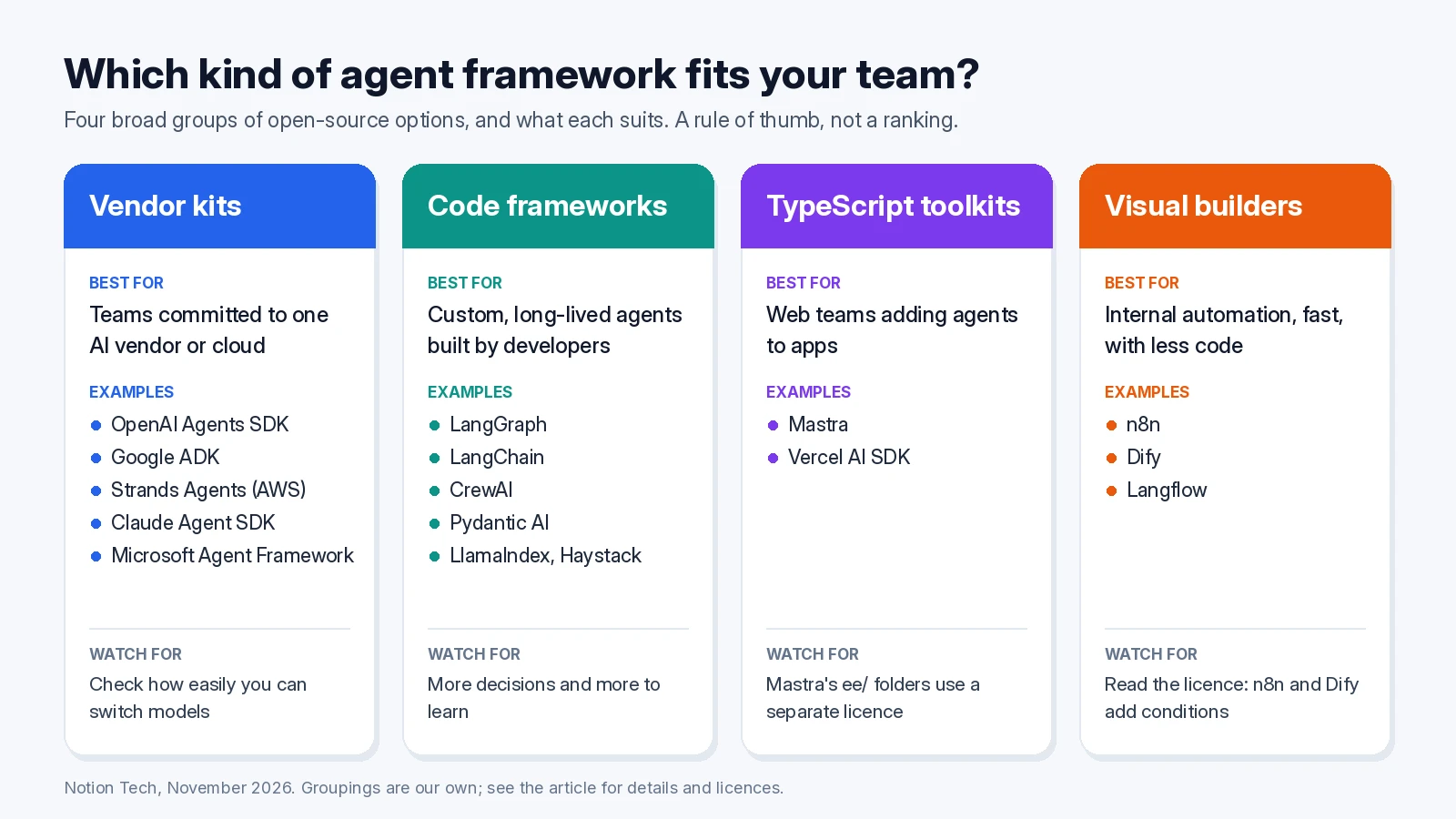
A rough rule of thumb, and it is only that: vendor kits suit businesses committed to one cloud; LangGraph, Pydantic AI and similar suit teams building something custom and long-lived; visual builders suit internal automation where speed matters more than fine control. Many real systems mix them, for example a visual builder for simple workflows and a code framework for the one process that really matters.
Honest trade-offs
Frameworks save time early and can cost time later. They get a prototype running in days. But when you hit something the framework wasn’t designed for, you may spend longer fighting its abstractions than you would have spent writing the code. AWS made a version of this point when it launched Strands, saying earlier frameworks had started to get in the way as models improved.
Stars and hype move faster than maturity. Several projects in this list have rewritten themselves from scratch or renamed their repositories in the past year. That’s normal in a young field, but it means a guide from 2025 may describe software that no longer exists in that form.
“Open source” doesn’t always mean free to resell. n8n, Dify and parts of Mastra carry conditions. That’s fine for internal use, and worth a proper read if you’re building a product.
The framework doesn’t make the agent safe. Guardrails, approval steps and tracing help, but they only work if someone configures them and checks the results. For Australian businesses, if an agent makes or assists decisions about people, the Privacy Act’s new automated decision transparency rules from 10 December 2026 apply no matter which framework you used.
A sensible first project
If you’re starting from nothing, keep the first agent small and boring:
- Pick one repetitive job with a clear right answer, such as sorting incoming enquiries or drafting quote follow-ups.
- Choose a framework that fits your team’s language and cloud, using the questions above.
- Give the agent read-only access first. Add the ability to act only once you trust its judgement, and put a human approval step on anything external.
- Turn on tracing from day one and have someone review a sample of runs each week.
- Track model costs per task. Multi-agent designs can multiply them.
- Review after a month: keep it, change it or switch it off.
That approach works with almost every framework in this list, and it tells you more about fit than any star count.
How we can help
We build AI agents for Australian businesses, and choosing the framework is one of the first decisions we make with clients. If you’d like a second opinion on a proposal, or help picking between a visual builder and a custom build, talk to our AI agents and automation team. If the agent needs to connect to your accounting, CRM or rostering software, our integrations and API development service covers that side. Still weighing whether to build at all? Our guide to custom software versus off-the-shelf walks through the same decision in general terms.
Repository descriptions in this article come from each project’s GitHub page, README and licence file, and from the linked AWS, Microsoft and Flowise announcements, all checked on 24 November 2026. Star counts, licences and last-push dates were fetched from the GitHub API at about 8:55pm Sydney time on 24 November 2026. We haven’t installed or benchmarked these frameworks. Repository preview images are GitHub’s own social preview cards, credited in their captions. This article is general information, not legal advice; read each licence in full before relying on it.