By the Notion Tech team · Published 13 November 2026 · Prices and details checked against official vendor pages on 13 November 2026
Four big model announcements landed in eight days. OpenAI released GPT-6 Cyber on 5 November. Anthropic shipped Claude Fable 5.2 and Mythos 5.2 on 9 November. Google made Gemini 4 Carbon generally available on 10 November, then followed with Gemini 4 Hydrogen on 12 November. If you run a business that already pays for an AI tool, or you’re planning one, that’s a lot of launch posts to wade through.
The short answer: for most Australian businesses, the most useful release this week is the cheapest one. Gemini 4 Hydrogen is Google’s fast, lower-cost model, and Google says it edges out its own frontier Argon model on one independent index. Carbon and Fable 5.2 are serious upgrades, but they’re priced and pitched at the hardest technical work. The bigger shift is the pattern behind all three: vendors now expect you to mix a big “planner” model with a cheap “worker” model, rather than running one model for everything.
This piece explains what each release is, what it costs, how to read the benchmark claims without getting fooled, and what we’d actually do this month if we were in your seat. We haven’t run our own benchmarks on these models yet, so every performance figure below is the vendor’s own claim, and we say so each time.
What actually launched
Gemini 4 Hydrogen (12 November)
Hydrogen is Google’s new everyday model. Google describes it as built “for rapid execution across diverse agentic workflows”, which in plain terms means it’s meant to do lots of steps quickly and cheaply: drafting, searching, editing code, running tests and calling tools.
The numbers Google published are worth knowing. In its launch post, Google says Hydrogen scores 51 on the Artificial Analysis Intelligence Index at its default “high” thinking level, against 50 for Gemini 4 Argon, and 54 at its new top “xhigh” level. It has a 1 million-token context window, and Google’s Gemini API pricing page lists it at US$1.50 per million input tokens and US$7.50 per million output tokens, flat across the whole window.
It’s also the widest rollout of the three. Google says Hydrogen is going to all tiers of Google AI Studio and the Gemini API, Gemini for business, the Gemini app and Google Search. Free Gemini app users get it through automatic model selection when Google decides it suits the prompt. Business users will also see it in Gemini in Google Sheets on eligible plans.
Gemini 4 Carbon (10 November)
Carbon is the other end of Google’s range. Google calls it “our strongest model”, aimed at long, multi-step coding, scientific research and cybersecurity work. It was first released two weeks earlier to a set of cyber defenders through Google’s Fairwind Program before the general release.
Two details matter for buyers. First, Google itself says Argon “remains the ideal choice for the majority of software engineering and knowledge work”, and that Carbon uses more tokens than Argon because it explores and checks its work more thoroughly. Second, the price is introductory. The pricing page lists Carbon at US$2 input and US$10 output per million tokens until 30 November 2026, then US$4 and US$20 from 1 December. The same page shows the same change for Argon. Carbon isn’t available on the free tier.
Claude Fable 5.2 and Mythos 5.2 (9 November)
Anthropic’s release is two names for one model. In its announcement, Anthropic explains that Fable and Mythos share the same underlying model. Fable ships with cybersecurity and biology safeguards and is open to everyone. Mythos has fewer of those blocks and is limited to organisations approved through Anthropic’s verification programs.
Anthropic says Fable 5.2 generates output up to 30% faster than Fable 5.1 and costs less: US$8 per million input tokens and US$40 per million output, down from US$10 and US$50 for 5.1 on its pricing page. An optional fast mode costs US$16 and US$80.
The most useful line in the whole post is Anthropic’s own advice on when not to use it. For most coding and knowledge work, Anthropic recommends starting with Claude Opus 5.5, “our strongest daily driver”, and moving up to Fable or down to Sonnet 5.5 or Haiku 5.5 depending on the job. That’s a vendor telling you its newest, priciest model isn’t the default. Take the hint.
GPT-6 Cyber (5 November)
OpenAI’s release is the one most businesses can ignore for now. GPT-6 Cyber is a security-focused version of GPT-6 Astra, built for authorised vulnerability research and exploit development. According to OpenAI’s announcement, it’s available only to a select group of approved customers in Daybreak Red, OpenAI’s vetted program for advanced security testing. OpenAI’s Daybreak help article says even turning on Daybreak Red doesn’t grant access to GPT-6 Cyber; it needs separate approval. OpenAI says it’s initially available through the API and Codex, so it isn’t a general ChatGPT model.
It does matter in one way. Models this capable at finding and exploiting flaws are now in the hands of vetted security teams, and the next security firm that tests your systems may well use one. The flip side is that the gap between a bug being found and being exploited is likely to keep shrinking, so patching quickly matters more than it used to.
The four releases side by side
Here’s the short version, using only what each vendor published. All prices are standard API list prices in US dollars per million tokens.
| Model | Released | Input / output price (US$ per 1M tokens) | Who can use it | Pitched at |
|---|---|---|---|---|
| Gemini 4 Hydrogen | 12 Nov 2026 | $1.50 / $7.50 | Everyone: free and paid API tiers, Gemini app, Search, Gemini for business | Fast, everyday agent work, coding and documents |
| Gemini 4 Carbon | 10 Nov 2026 | $2 / $10 until 30 Nov, then $4 / $20 | Paid API, Gemini for business, AI Ultra subscribers | Hardest long-running coding, research and security tasks |
| Claude Fable 5.2 | 9 Nov 2026 | $8 / $40 (fast mode $16 / $80) | All Claude platforms, plus AWS, Google Cloud and Microsoft Azure | Ambitious, open-ended technical work |
| Claude Mythos 5.2 | 9 Nov 2026 | $8 / $40 | Approved organisations only (cyber and life sciences programs) | Security and biomedical research |
| GPT-6 Cyber | 5 Nov 2026 | Not published in the announcement | Approved Daybreak Red customers only | Authorised security testing |
Two things jump out. Hydrogen is the only one of these with a free API tier. And the gap between the cheapest and dearest general-purpose model here is large: Fable 5.2’s output price is more than five times Hydrogen’s.
The real story: one big brain, many fast hands
If you read the Google and Anthropic posts back to back, they describe the same idea in different words.
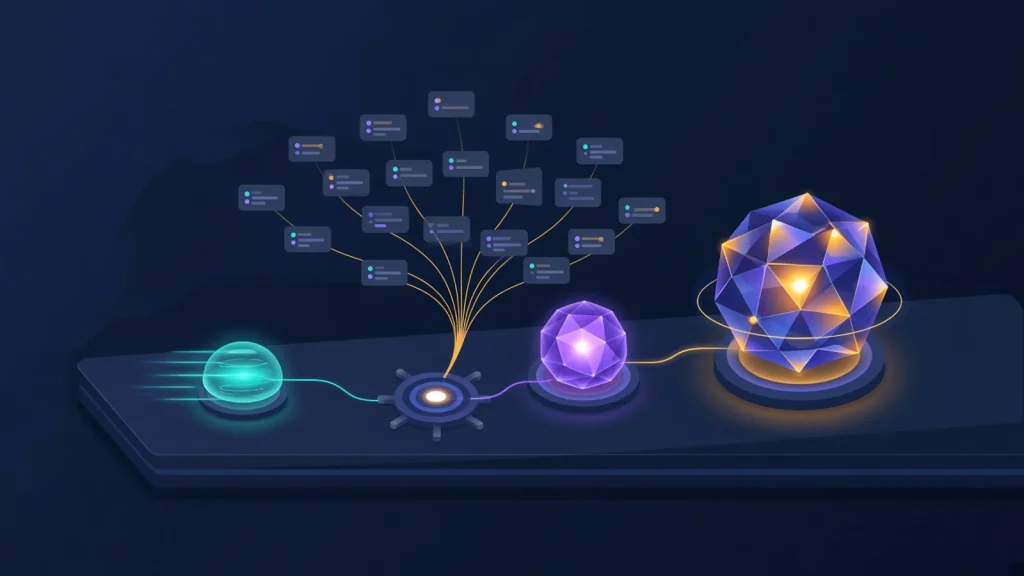
Google says Hydrogen can “pair with Carbon and Argon as the high-efficiency execution engine in multi-model workflows”. It launched a feature called Orchestrator in its Antigravity coding tool that switches between Carbon and Hydrogen inside one session. Google reports that on Terminal-Bench 4.0, Orchestrator reached near-Carbon success rates while using 24% less quota and finishing 19% faster on average. That’s Google’s own test, so treat it as a claim, not a guarantee.
Anthropic says Fable 5.2 can act as an “Advisor”, where Haiku, Sonnet or Opus consult it on harder problems, or as an “Orchestrator” that hands simpler tasks to smaller models.
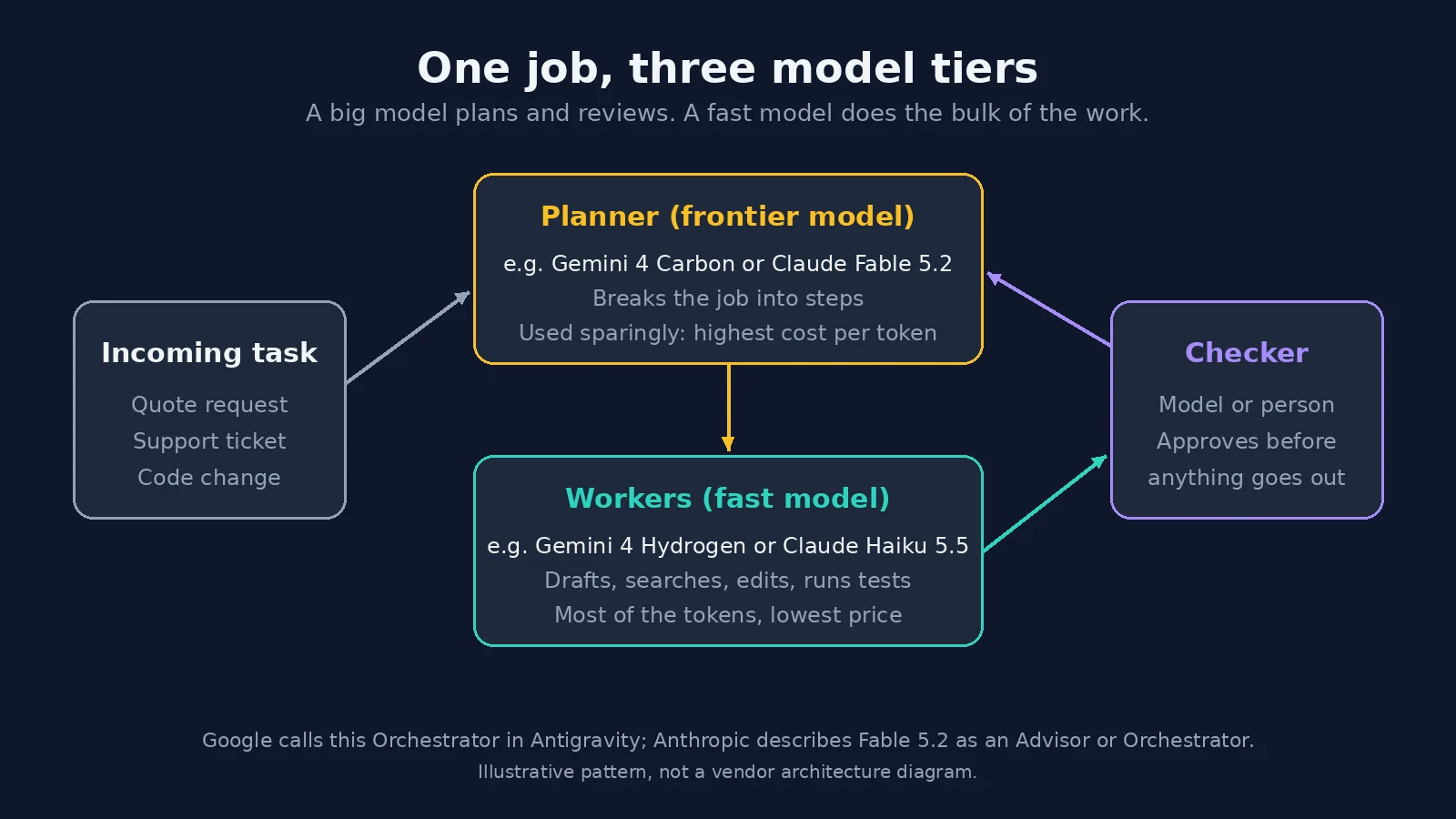
Why should a business owner care? Because it changes how you should think about cost. Most of the tokens in a real AI workflow go into the boring middle: reading documents, drafting replies, trying a fix, checking the result. If a cheap model can do that middle reliably, you only pay frontier prices for the few moments that need real judgement.
Here’s a concrete example. Say you run a trades business and want an assistant that turns a customer’s emailed photos and description into a draft quote. A bigger model might plan the job once: work out the scope, flag anything unusual and pick the right price list items. A fast model then pulls the item prices, fills in the quote template and writes the cover email. A person checks the quote before it goes out. You’d pay the higher rate for a small slice of the work and the lower rate for most of it.
The catch is that a split setup is more work to build and test. Two models means two sets of failure modes and a handover between them that can drop context. For a simple job, one mid-range model is often the better call. We’ve written before about which jobs AI agents actually handle well, and the same rule applies here: start with jobs that are frequent, well documented and easy to undo.
What it costs: a worked example
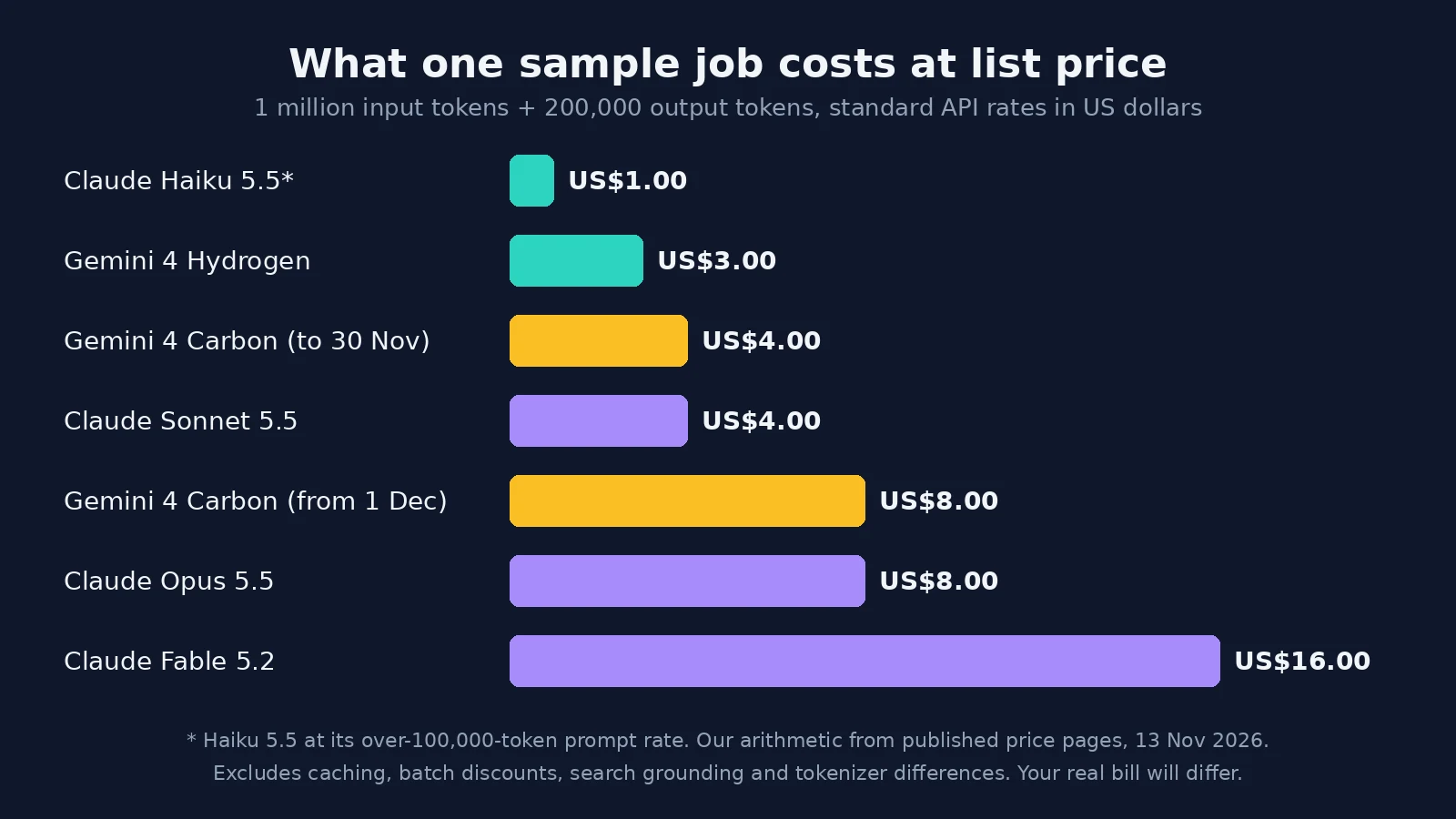
Per-token prices are hard to picture, so here’s one sample job priced at each model’s list rate. We’ve assumed 1 million input tokens and 200,000 output tokens. As a rough estimate of ours, not a measurement, that’s in the region of an assistant reading and answering a few hundred longer customer emails. Your own mix will vary a lot.
| Model | Input cost (1M tokens) | Output cost (200k tokens) | Total for the sample job |
|---|---|---|---|
| Claude Haiku 5.5 (prompts over 100k tokens) | US$0.50 | US$0.50 | US$1.00 |
| Gemini 4 Hydrogen | US$1.50 | US$1.50 | US$3.00 |
| Gemini 4 Carbon, to 30 Nov | US$2.00 | US$2.00 | US$4.00 |
| Claude Sonnet 5.5 | US$2.00 | US$2.00 | US$4.00 |
| Gemini 4 Carbon, from 1 Dec | US$4.00 | US$4.00 | US$8.00 |
| Claude Opus 5.5 | US$4.00 | US$4.00 | US$8.00 |
| Claude Fable 5.2 | US$8.00 | US$8.00 | US$16.00 |
This is our arithmetic from the published price pages, not a quote. A few things will move your real number:
- Thinking tokens count as output. Google’s pricing page says output pricing includes thinking tokens. A model set to think harder can produce far more output than the answer you see.
- Tokenisers differ. Anthropic says Claude 4.7 and later models use a newer tokeniser that produces about 30% more tokens for the same text. So the same email can cost a different number of tokens on Claude and Gemini.
- Caching and batching cut costs. Anthropic’s Batch API halves input and output prices for jobs that don’t need an instant answer, and both vendors discount cached prompts.
- You pay in US dollars. Your Australian dollar bill moves with the exchange rate, and GST treatment depends on how you’re billed. Check your invoices rather than assuming.
- Carbon’s price doubles on 1 December. If you build a budget around this month’s rate, it’ll be wrong in three weeks.
Haiku 5.5 is the cheapest line in the table, and it’s worth a look if you haven’t tried it. We left it out of the headline comparison because it isn’t one of this week’s releases, but it’s a reminder that “new” and “right for the job” aren’t the same thing.
How to read the benchmark claims
Every launch post is full of scores. Some are useful. Most need a pinch of salt.
Start with who ran the test. Nearly all the figures in these posts come from the vendor, on settings the vendor chose. Anthropic’s table, for example, notes that scores show “each model’s highest-available effort unless otherwise noted”. Google lists Hydrogen’s results on a long run of named benchmarks, but they’re still Google’s results.
Then look for the inconvenient numbers, because they’re often the most honest. In Anthropic’s own comparison table, Gemini 4 Carbon scores 53.9% on Zapier’s AutomationBench for business workflows, ahead of Fable 5.2 at 51.4%. Anthropic published that, which is to its credit. If business automation is your main use, that one row says more to you than a protein-design score ever will.
Finally, ask whether the test looks like your work. Fable 5.2 helped formalise the proof of Fermat’s Last Theorem in 30 hours, according to Anthropic. That’s genuinely impressive. It tells you almost nothing about whether it’ll file your supplier invoices correctly. Google’s claim that Hydrogen cuts “fabricated claims by more than 5x” compared with Gemini 3.8 Flash is far more relevant to everyday business use, and it’s exactly the kind of claim worth testing yourself.
The fix is simple, if a bit tedious. Build a small test set of 20 to 50 real tasks from your own business, with the answers you’d accept, and run every candidate model against it. Strip out anything confidential first. An afternoon of this beats a week of reading launch posts.
Safety, data and the Australian angle
All three vendors spent a lot of their launch posts on safety. Some of it is relevant to ordinary business use.
Prompt injection is still unsolved. Google says Hydrogen is more than 2.3 times more resilient than before on Gray Swan’s indirect prompt injection benchmark, and that Carbon recorded a 0% attack success rate on that benchmark. In the same breath, Google says “prompt injection robustness remains an area for continued improvement”. Believe the second part. If your agent reads emails, web pages or uploaded files, someone can hide instructions in them. Don’t let any model send money, delete records or email customers without a check.
Know what happens to your data. Google’s pricing page says data sent on the free tier of the Gemini API is “used to improve our products”. On the paid tier it says no. That one line matters if your staff are pasting customer details into a free tool. Anthropic says Fable 5.2 and Mythos 5.2 rely on safety monitoring across a window of usage, with 30-day retention for that monitoring unless you’re an eligible enterprise customer using zero data retention or its new Enterprise Frontier Safeguards beta.
Fable will refuse some security work. Anthropic says Fable 5.2’s safeguards block high-risk cyber tasks such as penetration testing and exploit generation, and hand the request to an older model instead. That’s sensible, but it can surprise a legitimate IT team mid-task.
For Australian businesses, these details feed straight into obligations you already have. The Privacy Act changes on automated decisions take effect on 10 December 2026, and we’ve covered what that means for software that makes or helps make decisions about people. If a model helps decide who gets a refund, a booking or a job interview, you’ll need to be able to explain that. Our summary of Australia’s AI safety rules for business covers the broader picture.
One more practical point: none of the launch posts promise that your data stays in Australia. Anthropic’s pricing page describes a US-only inference option at a 10% premium; it doesn’t describe an Australian one. If data location matters to your clients or contracts, check the specific cloud region and service you’d use, in writing, before you build.
Which model for which job
Here’s how we’d match common business jobs to this month’s options. These are starting points to test, not verdicts.
| Job | Where we’d start | Why |
|---|---|---|
| Drafting emails, summaries and reports | Gemini 4 Hydrogen or Claude Sonnet 5.5 | Cheap, fast and good enough for most writing, with a person checking |
| Reading long contracts, tenders or PDFs | Gemini 4 Hydrogen, with a bigger model to check edge cases | 1M-token window at a flat price; escalate only the hard clauses |
| Customer chat or a voice receptionist | A fast model you’ve tested on your own questions | Speed and consistency matter more than raw reasoning |
| Complex code changes or migrations | Claude Opus 5.5 first, then Fable 5.2 or Gemini 4 Carbon if needed | Both vendors say their top model is for the hardest jobs, not the default |
| Spreadsheet modelling inside Google Workspace | Gemini in Google Sheets, where your plan includes Hydrogen | It’s already where the data lives |
| Security testing of your own systems | A qualified security provider | The strongest cyber models are gated for good reason |
Notice that the newest, priciest models only show up for the hard jobs. That’s not us being cautious. It’s what Google and Anthropic say in their own posts.
What we’d do this month
If you already use AI tools in your business, here’s a short to-do list for the rest of November.
- Check which model your tools now use. Hydrogen is rolling into the Gemini app and Search, and free Gemini users may get it automatically. If your team relies on Gemini for drafts, spot-check the output for a week.
- Re-price anything built on Carbon or Argon before 1 December. The introductory rates end on 30 November. A workflow that’s cheap today will cost about twice as much in December.
- Test Hydrogen against whatever you pay for now. Use your own test set. If it matches your current model on your real tasks, the saving is easy money.
- Don’t upgrade to Fable 5.2 by default. Anthropic recommends starting with Opus 5.5. Move up only when a task actually fails on the cheaper model.
- Move staff off free tiers for business data. Free-tier data on the Gemini API is used to improve Google’s products. Paid tiers and business plans are the safer place for client information.
- Add a human check to anything that acts on its own. Better prompt injection scores don’t remove the risk. Approvals for payments, deletions and outbound messages are cheap insurance.
If you’re starting from scratch, don’t pick a model first. Pick one job, write down what “done well” looks like, then test two or three models against it. The model market will probably look different again within a few months. A well-defined job won’t.
The trade-offs nobody puts in the launch post
It’s worth being honest about what these releases don’t fix.
Faster, cheaper models make it tempting to automate everything at once. That’s usually a mistake. Each automated step is another place for a quiet error, and a cheap model making a lot of small mistakes can cost more in clean-up than a dearer one that gets it right.
Multi-model setups add moving parts. Routing between a planner and a worker sounds tidy in a diagram. In practice you need logging, fallbacks for when one vendor has an outage, and tests for the handover. If you’re a five-person business, one good model and a human check is often the smarter build.
Vendor lock-in is real too. Google’s Orchestrator lives inside Antigravity. Anthropic’s Advisor pattern works across its own model family. Both are reasons to keep your prompts, test sets and business logic in your own systems, so you can switch when prices or quality change. Our guide to custom versus off-the-shelf software walks through that trade-off in more detail.
And there’s plenty we can’t tell you yet. These models are days old. We haven’t seen independent long-term testing, real-world error rates in Australian business settings, or how prices will settle after the introductory periods. Anyone telling you with certainty which model wins this month is guessing.
Where this leaves you
This week’s releases are a clear step forward, but not a reason to rip anything out. The practical takeaways are short. Gemini 4 Hydrogen is worth testing straight away because it’s cheap and widely available. Carbon and Fable 5.2 are for your hardest problems, and both vendors say so. The planner-and-worker pattern is where the real savings are, if your use case is big enough to justify the extra build.
If you’d like help working out which model fits a real job in your business, or want an agent built with proper approvals and testing, our team does exactly that. Have a look at our AI agents and automation service, or see how we connect AI tools to the systems you already use.